- If you’ve been in SEO for even a short time, you’ve probably seen something that doesn’t quite make sense.
- A new website pops up out of nowhere. Within days or weeks, it starts ranking. Traffic flows in. Sometimes, it even begins earning money faster than sites that have been growing for months.
- At first, it feels confusing. Then it feels tempting.
- You start wondering if hard work is overrated, or worse—if you’re doing SEO the wrong way.
- This is usually the moment when people discover Black Hat SEO.
- But what most people see is only the surface. What they don’t see is what happens after that initial success.
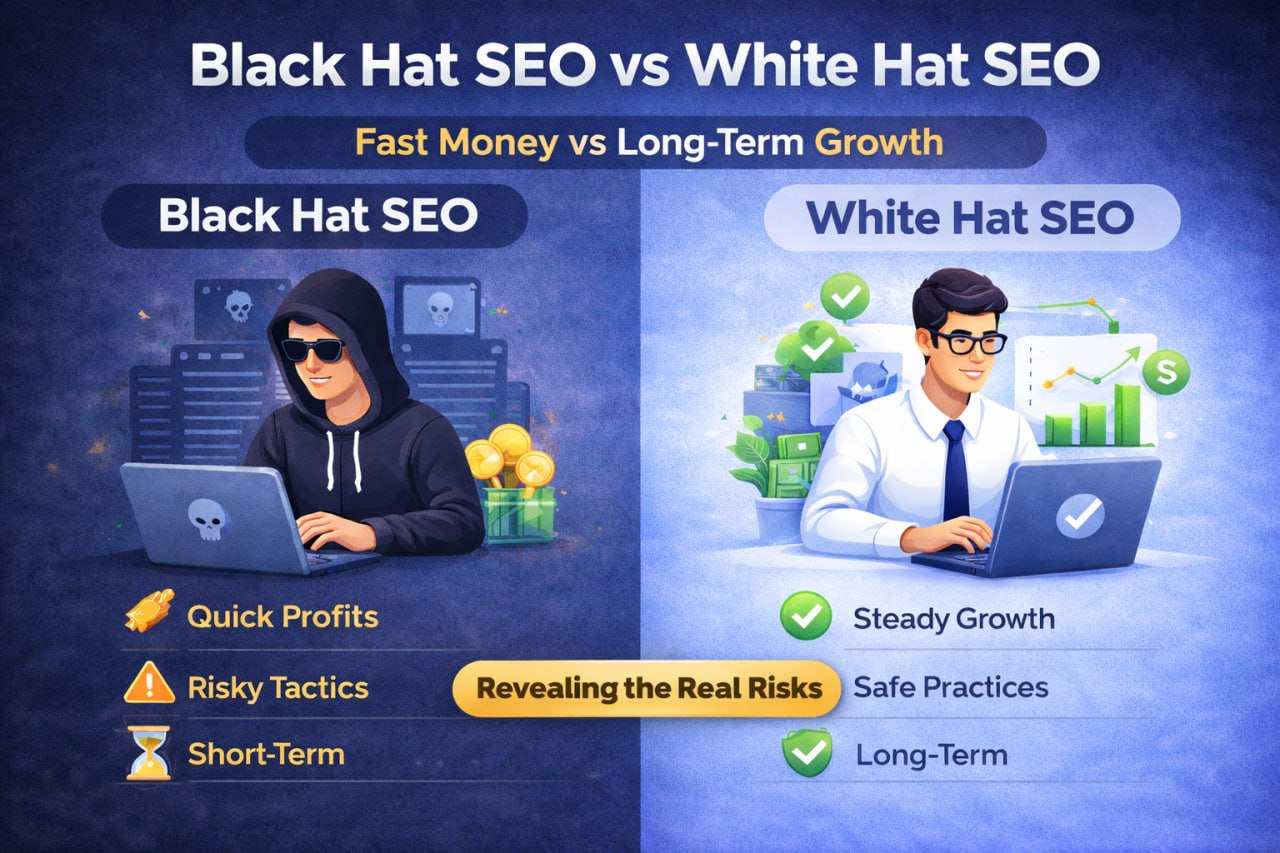
Why Black Hat SEO Looks So Attractive
Black Hat SEO isn’t popular because people are careless. It’s popular because, under the right conditions, it actually works.
Search engines are powerful, but they are not perfect in real time. There’s always a gap between when content is published and when it’s fully evaluated. That gap is where Black Hat strategies operate.
People take advantage of this by pushing large amounts of content quickly, often without focusing on organic quality. They might use automation, repurpose existing content, or build large amounts of backlinks in ways that look natural on the surface but are artificially created behind the scenes.
For a brief period, this can produce real results. Rankings improve. Traffic increases. Revenue starts to come in.
And that’s the moment most beginners get convinced.
The Part Nobody Shows You
What makes Black Hat SEO dangerous isn’t that it fails immediately. It’s that it doesn’t.
The success phase can last long enough to feel real. Long enough to build confidence. Sometimes even long enough to generate decent income.
But eventually, something changes.
Search engines re-evaluate your site over time. Signals that were initially ignored start getting processed. Patterns begin to stand out. And once that happens, the same system that rewarded you earlier starts pulling everything back.
This doesn’t always happen in a dramatic way. Sometimes rankings slowly decline. Pages stop indexing properly. Traffic becomes inconsistent.
Other times, it’s sudden. Entire sections of your site disappear from search results. Keywords you ranked for vanish overnight. In extreme cases, the site is removed entirely.
- The biggest problem isn’t just the loss — it’s having to start over completely.
- You’re not fixing a dip. You’re starting from zero again.
Why Some People Still Use It
Even after knowing the risks, some people continue to rely on Black Hat strategies. That’s because their goal is different.
They’re not trying to build a brand. They’re not thinking about long-term stability. They’re focused on short-term gains.
For them, a website is disposable.
They launch it, promote it aggressively, earn what they can, and move on when it starts declining. Then they repeat the process with a new domain.
From a purely tactical perspective, this can work. But it comes with trade-offs that most people underestimate.
There’s no predictability. No long-term asset. No compounding growth.
- It’s a cycle, not a system.
How White Hat SEO Actually Works Differently
White Hat SEO often gets dismissed as “slow,” but that description misses the bigger picture.
It’s not just about following rules—it’s about aligning with how search engines are designed to work.
Instead of trying to manipulate rankings, you’re building signals that naturally lead to better visibility.
The goal is to produce content that genuinely addresses user inquiries, presenting it in a clear and accessible manner, thereby enhancing the user's overall experience.
Initially, the progress seems small. You put out content, yet the audience is sparse. You improve your pages, but the impact isn't immediate.
However, something important is happening beneath the surface.
- Your site is building trust.
- And once that trust reaches a certain level, growth becomes much easier to sustain.
- The Compounding Effect Most Beginners Miss
- The biggest advantage of White Hat SEO isn’t safety—it’s compounding.
- Every piece of content you publish adds to your site’s overall authority. Every improvement you make strengthens your foundation. Over time, your efforts start reinforcing each other.
- This creates a completely different trajectory.
- Instead of spikes and crashes, you get gradual but consistent growth.
- Instead of restarting, you build on what you already have.
And eventually, you reach a point where new content ranks faster—not because you’re gaming the system, but because you’ve earned that position.
The AdSense Perspective: Where Most People Fail
If your goal includes monetization through AdSense, this distinction becomes even more important.
AdSense is not just evaluating whether you have traffic. It’s evaluating the quality and reliability of your content.
Sites that rely heavily on manipulative tactics often struggle here. Even if they manage to get approved, maintaining compliance becomes difficult.
Low-quality or repetitive content, poor user experience, and unnatural engagement patterns can lead to rejection—or worse, account suspension later.
On the other hand, a site built with genuine value stands a much better chance of both approval and long-term stability.
This is where many creators realize that shortcuts don’t just affect rankings—they affect revenue security.
The Smarter Approach in 2026
The most effective creators today are not blindly choosing one side. They understand the mechanics of both, but they apply that knowledge strategically.
They build their main projects with a long-term mindset. Clean structure, helpful content, and consistent improvement.
At the same time, some may experiment separately—testing ideas, understanding trends, and learning what works in different conditions.
The key difference is separation.
They don’t risk their primary asset for short-term gains.
Final Thoughts: Choosing the Right Game
At its core, this isn’t just a technical decision—it’s a strategic one.
- Black Hat SEO can offer speed, but it sacrifices stability.
- White Hat SEO requires patience, but it builds something that lasts.
The question is not which one works. Both can work in their own context.
The real question is what kind of outcome you want.
If you’re looking for quick results without long-term commitment, the risky path might seem appealing.
But if your goal is to build a reliable source of traffic, income, and growth, then the slower path is not a disadvantage—it’s an investment.
Because in the long run, the websites that survive are not the ones that found the fastest shortcut…
They’re the ones that built something worth finding.