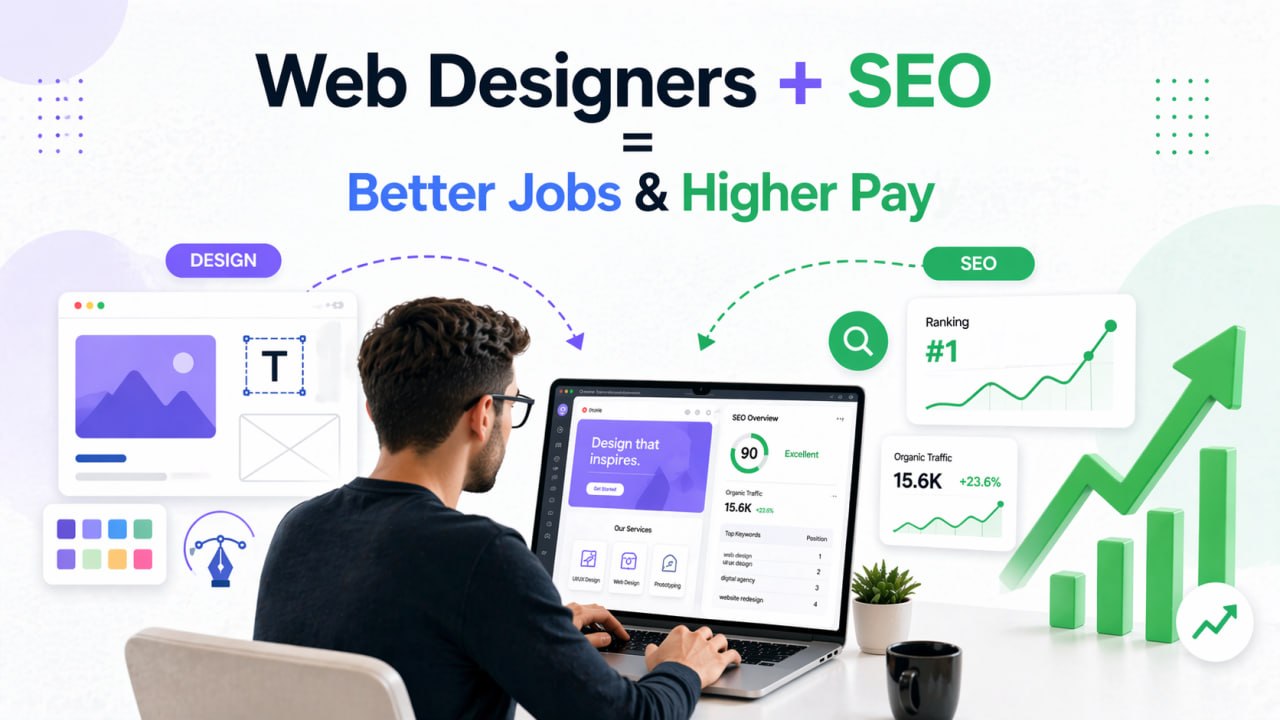
Introduction
Most web designers spend years improving their visual skills — cleaner layouts, better typography, smoother user experience. And that’s important. But there’s a gap that many don’t notice until it starts affecting their opportunities.
A well-designed website that doesn’t get traffic doesn’t solve a business problem. It just looks good.
And businesses aren’t paying for “good-looking” anymore. They’re paying for results.
That’s exactly where designers with SEO knowledge start pulling ahead — not because they design better visually, but because they understand what makes a website perform.
Where the Difference Actually Shows
If you look closely, the difference between an average designer and a high-value one isn’t always visible in the design itself. It shows in the thinking behind it.
A typical designer focuses on how a page looks when it’s finished. Someone with SEO awareness thinks about what happens after the page goes live — how users find it, how they interact with it, and whether they stay or leave.
That shift sounds small, but it completely changes how you approach design.
Instead of treating content as something to “fit into a layout,” you start structuring the layout around the content so both users and search engines can understand it easily. Headings become more than just styling choices. Spacing affects readability. Even the order of sections starts to matter.
Why This Skill Pays More
From a business perspective, the logic is simple. If a designer can influence traffic, engagement, and conversions — their work directly connects to revenue.
And anything connected to revenue gets valued higher.
That’s why two designers working on similar-looking websites can be paid very differently. One delivers a design file. The other delivers a system that helps the site get discovered and used.
Companies don’t always say this openly, but they naturally move toward people who reduce dependencies. If one person can handle both design thinking and basic SEO understanding, it removes friction in the entire process.
Less back-and-forth. Fewer mistakes. Faster results.
It’s Not About Becoming an SEO Expert
This is where a lot of designers overthink things. You don’t need to turn into a full-time SEO specialist.
What actually matters is awareness.
Understanding how structure affects search visibility. Knowing why page speed matters beyond just “performance scores.” Recognizing that a mobile layout isn’t just a smaller version of desktop, but often the primary experience.
These aren’t advanced SEO tactics. They’re foundational decisions — but they compound over time.
The Subtle Advantage Most People Miss
- There’s also a mindset shift that happens when you start combining design with SEO.
- You stop asking, “Does this look good?” and start asking, “Does this work?”
- That one change quietly puts you in a different category.
Because now, you’re not just presenting design — you’re explaining decisions. You’re connecting your work to outcomes. You’re thinking in terms of user behavior, not just visuals.
And that’s exactly what hiring managers and clients notice, even if they can’t always articulate it.
Why Opportunities Start Increasing
- Once you develop this combined skillset, something interesting happens.
- You don’t just get more opportunities — you start getting better ones.
Projects where the goal isn’t just to “make something look nice,” but to actually grow something. Roles where you’re trusted to think, not just execute.
Because at that level, design becomes part of a larger system — and you’re seen as someone who understands that system.
Final Thoughts
- The industry hasn’t loudly announced this shift, but it’s happening.
- Design alone is no longer enough to stand out. SEO alone isn’t enough either.
- But when you understand how both connect, you move into a space where your work has more impact — and naturally, more value.
- If you’re serious about growing as a designer, this isn’t an extra skill to “add later”.
- It’s the layer that turns your work from something that looks good… into something that actually works.